Skip to content

To Rome, With Love

Two years ago at this time I was in the midst of a once-in-a-lifetime trip to Rome. Soon after, I wrote this travel story for the Albany Times Union. It is my love letter to Rome. (Be sure to click through my photos at the top of the TU link):

When in Rome… Read more

For moms everywhere, on the Feast of St. Monica

Just about one year ago, when I spent 11 days in Rome, I had the chance to visit the Church of St. Augustine (seen here) multiple times since it was just around the corner from Santa Croce University, where I was attending a seminar for journalists.

In this beautiful church, complete with an altar and angels by Bernini and paintings by Raphael and Caravaggio, is the tomb of St. Augustine’s mother, Monica, whose feast we celebrate today.

I knelt before her tomb, so grateful just to be in Rome, and whispered prayers for all the moms who had asked me to remember their intentions while I was in the Eternal City. And I prayed for mothers everywhere, because no matter what our background, no matter how much we do, we often think its not enough, that we are not enough.

So today, as then, I am remembering all the moms I know and those I don’t, praying we find the patience and strength we need to live out our vocations fully and joyfully and that we also have eyes to see not only where we think we fall short but where we are doing our best — teaching our children, serving our families, trusting in God — day after day, year after year.

I remembered all of you this morning as I said Morning Prayer, and I will remember you again in just a little while when I go to Mass. Please remember me in your prayers as well. And let us turn to St. Monica for comfort when we do come up against those hard times and wonder how we will get through. She was living proof that the power of persistent prayer can change lives — our own and those of our children.

Sundials and solstice disks at St. Peter’s

When I went to Rome in September, my watch stopped working on my first day in the Eternal City. My initial reaction was to run out and, through pointing and gestures and lots of “grazies,” try to buy a new one. Then I decided to take the Roman approach and not worry so much about time.

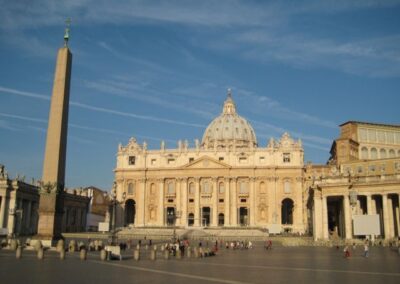
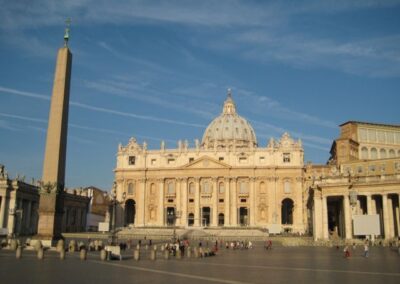
Turns out I never had to worry at all. St. Peter’s Square is equipped with its own sundial, as well as markers to indicate the solstices and even the days when the sun enters various signs of the zodiac.

From a CNS story by Carol Glatz:

Hidden among the paving stones of St. Peter’s Square there is a simple clock and calendar. All you need is a sunny day.

The 83-foot stone obelisk in the middle of the square acts as a sundial that can accurately indicate midday and the two solstices thanks to a granite meridian and marble markers embedded in the square.

Pope Benedict XVI proudly pointed out the hidden timepiece during an Angelus address he gave on the winter solstice a few years ago.

“The great obelisk casts its shadow in a line that runs along the paving stones toward the fountain beneath this window and in these days, the shadow is at its longest of the year,” he told pilgrims from the window of his library.

In fact, at noon on Dec. 21, the obelisk’s shadow falls on the marble disk furthest from the obelisk’s base, while at noon on June 21 — the summer solstice — the tip of the shadow will fall just a few yards from the obelisk. In between are five other disks marking when the sun enters into which sign of the zodiac.

A long, thin granite strip running from the obelisk toward the pope’s window and through one of the fountains acts as the meridian: a line that indicates when the sun has reached true or solar noon and is at its highest point in the sky.

The pope, in his solstice soliloquy, reminded people that the church has always been keenly interested in astronomy to help guide and establish fundamental liturgical days and the times of prayer such as the Angelus, which is recited in the morning, at noon and in the evening. While sunrise and sunset are easy to figure out, sundials could accurately tell midday, he said.

The CNS story also points out that at the Basilica of St. Mary of the Angels and Martyrs, Pope Clement XI even had an astronomer build meridians to mark not only the noon hour but to “to make highly accurate celestial observations and solve complex astronomical problems.”

More from the CNS story:

John Heilbron, emeritus professor of history at the University of California, Berkeley, told Catholic News Service that St. Mary of the Angels “could do things you couldn’t do with telescopes at the time” like find out precise information about the inclination of the Earth’s axis.

Heilbron, who wrote “The Sun in the Church: Cathedrals as Solar Observatories,” said the basilica’s meridian was also used “to establish a very good value for the length of the year.”

It’s fascinating stuff. And the facts once again give lie to the argument that the Church is opposed to science. Read the full story HERE.

Summer blossoms, stuffed and fried UPDATED

When I went to Rome last September, I roamed from restaurant to restaurant, desperately asking (in my pathetic version of Italian): “Fiori di zucca fritta?” Fried zucchini blossoms? And the answer was a resounding: “No, not in season.” Argh. Read more

Listen with the ear of your heart…

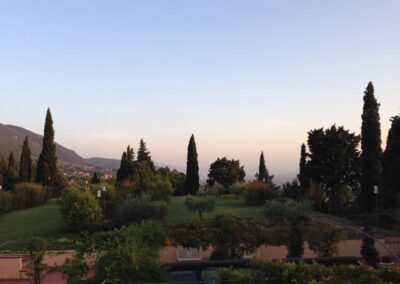
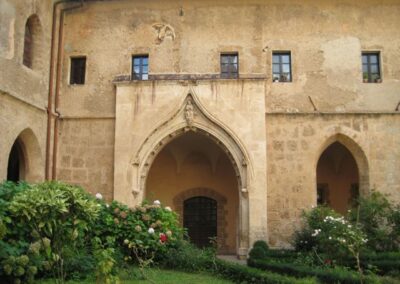
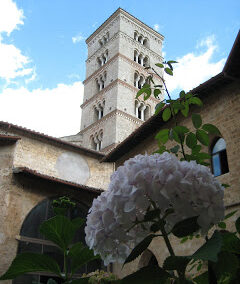
From the Monastery of St. Scholastica in Subiaco, Italy.
Photo by Mary DeTurris Poust

Happy Feast of St. Benedict! Here’s a snippet about St. Benedict from my newest book, The Essential Guide to Catholic Prayer and the Mass:

“While the Rule of St. Benedict covers everything from how much wine the monks were allowed to drink with dinner to receiving guests at the monastery, it’s still very much relevant to our lives today. Even the parts about moderation in food and drink can be adapted to our modern lives.

“St. Benedict opens the Rule with these words: ‘Listen with the ear of your heart.’ That’s a favorite quote of mine, and it hangs on a stone plaque in my office. It gets to the heart of prayer life, and the heart of life in general. We’re not meant to run from one thing to another without focus, without peace, without direction. We need to stop, breathe, be quiet, and listen with our hearts.

“…St. Benedict teaches us to live an integrated life. So prayer is woven into the work we do each day, whether we drive a bus, balance budget sheets, or care for our children. Our community is our family, our friends, our parish, our workplace. And our study? Well, we’re doing that right now as we attempt to learn more about faith and prayer in order to grow closer to Christ.

“So if we lean toward a holistic view of spirituality, of our faith as intricately woven into every moment and event of our lives, then Benedictine spirituality could be a path to explore…”

In the footsteps of St. Benedict…

With a breathtaking valley stretching out below and an ancient monastery clinging to the cliffs above, Subiaco, Italy, feels as though it is a world away from the chaotic streets of Rome, only 40 miles to its west. And, in a sense, it is.

Steeped in history that stretches back to the Roman Empire and the earliest centuries of the Roman Catholic Church, Subiaco is a place out of time, giving visitors a chance to step into the very same cloisters, caves and gardens that were once home to ancient saints and medieval monks. Read more

On St. Scholastica’s feast, a view from Subiaco

When I was in Italy this past September, the final full day of the trip included a daylong visit to the Monastery of St. Benedict and the Monastery of St. Scholastica in Subiaco, just an hour’s bus ride from Rome. It was a beautiful day, filled with awesome sights and spiritual inspiration. So today, on the Feast of St. Scholastica, I thought I’d share some photos from the monastery that bears her name. Read more